

When your windshield gets replaced, the glass going back into your vehicle isn’t all the same.
OEM and aftermarket glass are two distinct categories with real differences in fit, optical clarity, and how well they hold up over time.
If you’re filing an insurance claim or paying out of pocket in the Twin Cities, Hastings, or Red Wing area, understanding those differences before you say yes to a shop matters.
OEM vs Aftermarket Auto Glass Explained
OEM (Original Equipment Manufacturer): The gold standard for replacements. This glass is built to your vehicle’s exact factory blueprints, matching the original thickness, tint, and specialized coatings perfectly.
OEM-Equivalent: The “name-brand” alternative. These parts meet the same rigorous specifications as OEM glass and are produced by certified manufacturers, but they don’t carry the vehicle maker’s logo.
Aftermarket Glass: The budget-friendly option. This glass is designed for general fitment across various models rather than a specific car. To keep costs low, it often has looser tolerances, which can result in thinner glass or less effective UV and acoustic protection.
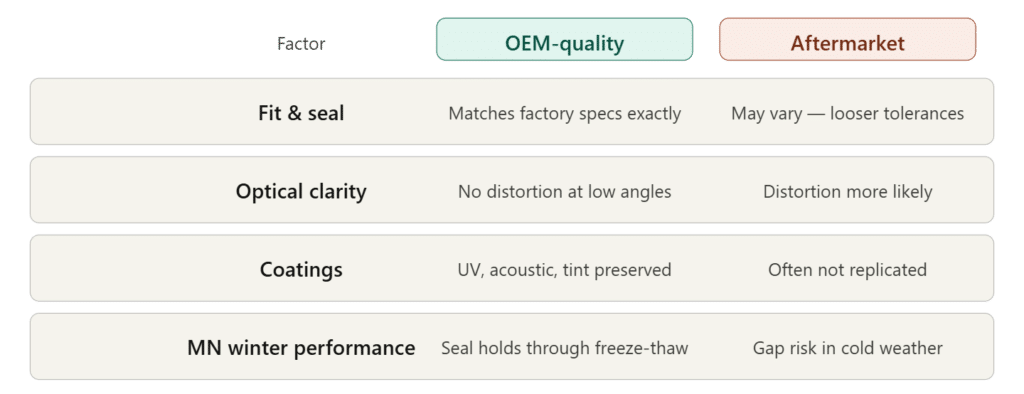
OEM vs Aftermarket Glass: Key Differences
The differences between OEM and aftermarket glass aren’t always obvious at first, but they show up quickly in everyday driving, especially in Minnesota conditions.
Where the differences show up:
- Optical clarity: Aftermarket glass can cause subtle distortion, especially in low-angle light
- Fit and sealing: Less precise fit may lead to wind noise, leaks, or drafts
- Cold-weather performance: Poor seals are more noticeable during freeze-thaw cycles
- Adhesive performance: High-quality adhesives are critical for structural strength and safety
- ADAS compatibility: OEM-quality glass helps ensure proper camera alignment and calibration
Over time, these differences affect comfort, visibility, and long-term durability. Choosing the right glass upfront helps avoid issues that are harder and more expensive to fix later.
Questions to Ask Before Choosing Auto Glass
Most drivers don’t know they can ask about glass quality before the work gets scheduled. You can, and you should. These are the right questions:
- What brand of glass are you installing, and is it OEM-quality or aftermarket?
- What adhesive do you use, and what is the drive-away time after installation?
- Do you manage my insurance claim directly, or do I have to coordinate separately?
- Is the installation backed by any workmanship warranty?
Ryan & Gordy’s Glass has been answering these questions since 1972. Their technicians are AGA-certified and members of the National Glass Association.
Every installation uses Sika adhesives, and they work directly with insurance companies to handle claims, so you’re not making separate calls and tracking down reimbursements on your own.
Tony M., a customer who recently had a windshield replaced, described the experience: “They initiated the insurance process, I was assisted through all aspects of this process. Windshield was ordered, and I had an appointment for Monday morning. Dropped the car off a little before 10, and they delivered it back to me a little after 12.”
That’s the kind of process that makes a frustrating situation easy.
Which Is Better: OEM or Aftermarket Glass?
- Choose OEM/OEM-equivalent for fit, clarity, ADAS accuracy
- Choose aftermarket for lower upfront cost
- Long-term value vs short-term savings
Get a Free Estimate from Ryan & Gordy’s Glass
If you need a windshield replacement, get a clear answer on your options before committing.
The Ryan & Gordy’s Glass team will walk you through OEM, OEM-equivalent, and aftermarket choices so you know exactly what you’re getting.
Call for a free estimate or request service online.
Auto Glass FAQs
Will my insurance cover OEM glass?
Many comprehensive policies cover windshield replacement, and some specify OEM or OEM-equivalent glass. Ryan & Gordy’s works directly with all insurance companies and can tell you exactly what your policy covers before the work starts.
How do I know if my windshield needs repair or full replacement?
The general rule: chips smaller than a quarter and cracks shorter than six inches may be repairable. Location and depth matter too. A technician needs to assess it directly, and Ryan & Gordy’s offers free estimates.
What is the drive-away time after a windshield replacement?
With Sika adhesives, drive-away time is typically one hour, but it varies by temperature and conditions. Your technician will give you a specific window based on the day’s conditions.
Does glass quality affect ADAS camera calibration?
Yes. Vehicles with advanced driver assistance systems (ADAS), like lane departure warnings and automatic emergency braking, have cameras mounted to the windshield. OEM-quality glass ensures the camera sits at the correct angle. Aftermarket glass with slight curvature variations can throw off calibration.
Do you offer mobile service in the Red Wing and Hastings area?
Yes. Ryan & Gordy’s Glass offers mobile service throughout their Minnesota and Wisconsin service area, including Red Wing and Hastings.